Wednesday, May 19, 2010
CONGRATULATIONS TO JOHN TRAVOLTA AND KELLY PRESTON!!!!!!!!
NEW YORK (CBS) News that John Travolta and Kelly Preston are expecting a baby in November shouldn't have come as a surprise to anyone.
The two middle-aged actors have been talking about expanding their family for years, even before their oldest child, son Jett, died last year. Preston is 47.
Pictures: John Travolta
Pictures: Pregnant Celebrities
Pictures: Scientology's Stars
"[The pregnancy] is not a shock to anyone in their camp," Gossip reporter Paula Froelich told CBS' The Early Show this morning. The two have made a "concerted effort" to have another child together, she said.
But Travolta, 56, was talking about a third child as far back as March 2007 when he told People magazine he and Preston "were trying for a third but that depends on Kelly's schedule. I leave it up to her."
At the time, he said, "I really like having kids. I enjoy their energy and it keeps everything wonderful and hopeful. I grew up with six kids in my family. I thought I would have five or six."
Jett Travolta, who suffered from autism , was just 16 when he died in January 2009 after suffering a seizure at the family's vacation home in the Bahamas. The couple also has a daughter , Ella Bleu, who is 10.
The Travoltas made news earlier this week when it was learned that two of the family's dogs were killed in a freak accident last week at an airport in Bangor, Maine , where the couple has a home.
HOW EXCITING IS THIS???????????????????????!!!!!!!!!!!!!!!!!!! I mean they loose Jett to a terrible accident in the Bahamas a year ago and now they are expecting. If you have seen any of the movies where John plays a dad you know he is a great one, plus he has said many times that in his filming contract he has to be home for dinner with the family no matter where he is. This is so incredibly awesome! Here's to another beautiful Travolta baby and a healthy pregnancy for Kelly!
Tuesday, May 18, 2010
It is time for a FIRST Wild Card Tour book review! If you wish to join the FIRST blog alliance, just click the button. We are a group of reviewers who tour Christian books. A Wild Card post includes a brief bio of the author and a full chapter from each book toured. The reason it is called a FIRST Wild Card Tour is that you never know if the book will be fiction, non~fiction, for young, or for old...or for somewhere in between! Enjoy your free peek into the book!You never know when I might play a wild card on you!
Today's Wild Card author is:
and the book:
Realms; 1 edition (May 4, 2010)
ABOUT THE AUTHOR:
Born in Baltimore, Maryland, Mike now lives in Hanover, Pennsylvania, with his wife, Jen, and their three daughters. He is a regular columnist for AVirtuousWoman.org, was a newspaper correspondent/columnist for over three years, has published several articles for The Candle of Prayer inspirational booklets, and has edited and contributed to numerous Christian-themed Web sites and e-newsletters. Mike is a member of the American Christian Fiction Writers association, the Christian Fiction Blog Alliance, the Relief Writer’s Network, and FaithWriters, and plans to join International Thriller Writers once published. He received his BA degree in sports exercise and medicine from Messiah College and his MBS degree in theology from Master’s Graduate School of Divinity. Visit the author's website.
Product Details:
List Price: $13.99
Paperback: 281 pages
Publisher: Realms; 1 edition (May 4, 2010)
Language: English
ISBN-10: 1599799189
ISBN-13: 978-1599799186
AND NOW...THE FIRST CHAPTER:

Present day
As he pressed his beat-up Ford down an uneven stretch of asphalt, Rob Shields had death on his mind. His own. The void within him had grown to colossal proportions, opening its gaping black maw and swallowing any hope or happiness he once had. Lost forever. No chance of return. Death welcomed him, enticed him, drew him in with its easy ways and comfortable charm.
Oh, he knew he would never do it. Taking his own life had a certain appeal to it, held a certain freedom that his bleak outlook on life longed for, but it took a much braver— or dumber—man than he to actually pull it off. But still he wanted, maybe needed, to pretend he was as serious as murder. And that meant it was time to see the house. If he was to fantasize about putting an end to his journey, he at least wanted to see the place that had promised a better life. Just one visit, one look, would satisfy him.
He glanced over at the empty passenger seat then into the rearview mirror at the vacant spot in the backseat. Kelly would be jabbering about what beautiful country this was.
“Look at the wildflowers. Oh, I love wildflowers.”
And little Jimmy would be singing away to his MP3 player, getting the lyrics all wrong.
Man, he missed them.
A familiar sadness overcame him, and he once again thought of his own death. He couldn’t bear to live without them any longer . . .
Life had become a great burden, an endless source of sadness. Every day was lived in despair. Unhappiness and discontent had become his bedfellows. He would see the
house, allow himself one evening of pleasant dreams about what could have been, then return to Massachusetts to live out the rest of his life in isolated misery. And in his mind,
that in itself was a form of suicide. A living death.
Rob depressed the accelerator, and the odometer needle climbed nearer to seventy. On the horizon, heat devils performed an arrhythmic dance, and the sun-scorched
blacktop appeared to be glossed with mercury. The road cut through pastureland like a hardened artery. To his right, a handful of horses stood motionless, their noses to the ground. To his left, the land stretched out like a green sea, undulating slowly to an even tempo.
Mayfield had to be no more than an hour away, but the fuel
gauge said he needed gas now. Up ahead, an elderly man in a ball cap was on both knees working his garden. Rob slowed the car and stopped beside him. The older gent turned his body slowly, revealing a patch over one eye.
Rob leaned across the center console and spoke loudly. “Where’s the nearest gas station?”
The old man cupped one hand around his ear and raised his eyebrows.
Rob said it louder. “Where’s the nearest gas station?”
The man nodded in the direction Rob had been traveling. “’Bout a mile down the road. Shell station on the left.”
“Thanks,” Rob said, and he pulled away. In the rearview mirror he could see the man watch him for a moment then return to his garden.
Exactly one mile down the road Rob steered into a cracked-asphalt lot and up to an old-style analog gas pump, the kind with the rotating numbers. He didn’t even know those kind still existed. The station had seen better days. From the sun-bleached Shell sign to the grime-coated plate-glass window of the little convenience store to the scarred and faded blacktop, everything spoke of neglect. This was one outpost time had forgotten.
Rob got out of the car and noticed the handwritten sign on the pump: Pre-pay inside. Management.
Walking across the lot, he could feel the day’s heat radiating through the soles of his shoes. A little bell chimed when he opened the door. A thin, fair-skinned man with shoulder-length hair nodded at him from behind the counter.
“Thirty in gas,” Rob said, reaching for his wallet.
The clerk punched some buttons on the register and said, “Thirty.”
Rob paid him. “How far to Mayfield?”
The clerk looked up. “Where?”
“Mayfield.”
After a quick shrug, “Fifty, sixty miles.” He looked like he wanted to say more, so Rob waited. “Not much in Mayfield.”
“A house,” Rob said.
“Your house?”
“Should have been.” Then he turned and left. The bell chimed again on his way out.
At the pump, Rob unscrewed the fuel cap and inserted the nozzle. Jimmy always loved to squeeze the trigger.
“Can I pull the trigger, Daddy?”
That’s what he called it, a trigger. He’d pretend the nozzle was a cowboy gun. Thoughts of his son flooded Rob’s mind, and he did nothing to stop them. Now was a time for remembering, for soaking up every good feeling and every fond image left to enjoy.
When the rolling numbers hit seventeen dollars, a quick movement caught Rob’s attention. He jerked his head up and toward the side of the store where a stand of shrubs sat quiet and motionless. Then he heard it, a muffled giggle, and his breath caught in his throat. He knew that giggle. Knew it like the sound of his own voice. The movement was there again. An image ran from the shrubs to the rear of the store and out of sight. The nozzle snapped off and fell to the ground with a solid clunk. Rob knew that run too, the shortened stride, the slightly exaggerated pumping of the arms. He could feel his heart thudding all the way down to his fingertips.
It was Jimmy. His little buddy.
Crossing the lot in large walking strides at first, then a run, Rob rounded the building fully expecting to find his son, Jimmy, red-faced with brown hair matted to his forehead,
waiting in a crouch to scare him.
“I got you, Daddy!”
Instead, all he found were a few rusted-out fifty-gallon drums, a stack of dry-rotted tires, and a haphazard pile of rebar. His breathing rate had quickened from the short sprint, and beads of sweat now popped out on his forehead and upper lip. He wiped them away with the sleeve of his T-shirt.
He walked the length of the building, scanning the field of
knee-high grass behind it. “Jimmy?”
But no answer came. Not even a rustle of grass. And no giggle.
“Jimmy,” Rob said in a normal volume, more to himself than the phantom of his son that had haunted him now for going on two months. The visions—the psychologist called
them hallucinations—had come frequently at first, sometimes as much as once a day, then grew more sporadic. Until now, he hadn’t had one for over two weeks. At first,
Rob was convinced there was a purpose to them, a meaning. Maybe they even meant Jimmy was still alive, waiting for his daddy to find him and rescue him. Maybe. The psychologist disagreed. Rob thought he was a quack and stopped attending the weekly sessions.
Scolding himself for once again allowing his frazzled imagination to dupe him, Rob returned to his car like a man taking his final stroll down the long corridor to the electric
chair. The sun’s heat now seemed more intense, and his shirt clung to his back and chest.
He picked the nozzle up from the ground and balanced it in his hand.
“Can I pull the trigger, Daddy?”
Every time he pumped gas he’d think of Jimmy. It was one of those little things that would haunt him the rest of his life. But it was a haunting he welcomed. After squeezing out the rest of his thirty bucks, Rob returned the nozzle to the pump, opened the car door, and was hit by a breath of heat.
Sitting in his car was like hanging out in an oven, but Rob did not turn the ignition. The air outside was still and the heat sweltering. Sweat seeped from his pores, wetting the front of his shirt. He thought of the image of his son and that familiar gait and noticed his hands were trembling. Tears formed in his eyes, blurring his vision.
“Jimmy.” He said the name again, as if it were some holy word that could cross the span of the finite and infinite and bring his little boy back. He wanted to hold him, bury his
face in Jimmy’s hair, and draw in the smell of sweat and cookies.
“I like how you smell, Daddy. You smell like a daddy.”
Wiping the tears from his eyes, Rob started the car, pulled away from the pump, and headed east toward Mayfield.
As he drove, the empty seats beside and behind him burned like hot coals. As much as he tried, he could not dismiss the memory of Kelly reaching over and placing a graceful hand on his thigh, her hair rippling in the wind, a smile stretched across her face. Nor could he stop glancing in the rearview mirror, half hoping to see Jimmy bouncing against the back of the seat.
Rob slapped at the steering wheel. He knew he was going mad, that the solitude of the last three months had nearly driven him over the edge and blurred the line between reality and fantasy. And he was obsessing again. He had to think of something else, so he turned his mind to the house his great-aunt Wilda had left him. He’d never seen the place, had never even met Wilda. But when he found out he was the sole heir to the house, his mother raved about how much Kelly and Jimmy would love the place. That was six months ago.
Before his world got flipped on its head and everything went to pot.
Before he went insane and entertained thoughts of death. The boy and his mommy walk back to the car to clean his hands. He’s been working on a candy apple for some time, and it’s creating quite the mess. Daddy told them he’d meet them at the lemonade stand. Lemonade is great for a warm day, he said. The grass in the parking area is brown and ground into the dry dirt from everyone walking and driving on it. His mommy is holding his clean hand and singing a Sunday school song about Joshua and the battle of Jericho. The boy is still thinking about the eagle the man behind the table was holding. He never knew eagles were so big. And when it looked at him, it seemed to see right past his skin and into his insides. They had other things at the stand too—an owl with big yellow eyes, a couple different kinds of snakes, and an aquarium full of toads—but the eagle was his favorite. He wondered what it would be like to be able to fly like an eagle, way up in the sky where no one could bother you, seeing the whole world at once.
“Here we are,” Mommy says. Their car looks extra clean because Daddy washed it just before they left. The black paint looks like a dark mirror and makes him look funny, like one of those curvy mirrors at the carnival.
Mommy opens the trunk and leans over into it, looking for the napkins. It reminds him of a poem about a crocodile with a toothache. He wishes he could remember all the words. Something about the crocodile opening so wide and the dentist climbing inside, then SNAP! Mommy always claps her hands real hard at that part, and it always makes him jump.
A man comes up behind Mommy. He’s wearing dirty old blue jeans and a tight black T-shirt. His face is big and round, and there are a lot of little scars on his cheeks. His eyes are placed real close together and pushed back into his head. With his shaggy hair and large face, the boy thinks he looks like a head of cabbage.
“Excuse me,” the man says. He reaches out to touch Mommy’s hip then looks at the boy.
Mommy jumps and stands up fast. She turns around and looks at the man, crossing her arms in front of her. She seems nervous. “Yes?”
Cabbage Head looks nervous too. He pushes his hand through his hair, and the boy notices the sweat on his forehead. It makes his hair wet where it comes out of the skin. “It’s your husband—”
Now Mommy looks scared. “Wha–what’s wrong?” Her voice shakes.
“I need you to come with me.” He looks at the boy with those deep eyes then back at Mommy. “The boy can stay here at the car. We’ll only be a minute.”
Mommy bites her lower lip and looks around. She kneels beside the boy. She looks real scared and is breathing fast. Her hands are shaking, and she’s still biting her lower lip. “Stay here, OK? Don’t leave the car. I’ll be right back. Don’t leave the car.”
She hugs the boy then kisses him on the cheek. Opening the back door of the car, she motions for the boy to get in. “Remember, stay here. Don’t go anywhere. I’ll be back for you soon.” She closes the door, blows him a kiss, and leaves with Cabbage Head. The boy watches as they walk away and disappear behind a trailer.
It doesn’t take long for it to get too hot to stay in the car. He opens the door and slides out, staying low to the ground so no one will see him. He leans against the car, but the black metal is too hot. So he sits Indian-style on the ground next to the back tire and picks at the grass. He wonders what could be wrong with Daddy. Did he have a heart attack or get cancer? Mr. Davies next door got cancer last year and died. This scares the boy. Maybe Daddy’s just lost and the man needs Mommy to help find him. He thinks about the man and his deep eyes. They were like the eagle’s eyes. Something about them didn’t look right, though. The boy feels like if he looked at them long enough he’d see things that would give him nightmares for a very long time. And they would see things in him too.
It seems like a long time of sitting by the tire and picking at brown grass before the boy hears footsteps coming, the sound of dry grass crunching like stale potato chips. He stands and looks around, hoping it’s Mommy. But Cabbage Head is coming toward him, alone. Where’s Mommy? Is she with Daddy, and the man is coming to take him to them?
Cabbage Head comes close. He’s sweating even worse now, and his hair looks like it has been messed up. He offers the boy his hand, a big meaty thing that looks like a bear’s paw. “C’mon, son. You must come with me.”
“Where’s my mom?” the boy asks. He notices his own voice is shaking.
“She’s fine. She wants me to bring you to her.”
The boy can tell the man is lying. He wants to run away but is afraid he’ll never find Mommy or Daddy on his own. “Where is she?”
Cabbage Head closes his hand and opens it again. His wide palm is all shiny with sweat. “Come. She’s waiting for you.”
There’s no way the boy is going to hold the man’s hand. He turns to run but the man catches him by the arm. “Oh, no, you don’t. You’re coming with me.”
The boy tries to holler, but the man’s sweaty hand is over his mouth, pressing so hard it hurts. The boy has never known what it is like to be so scared. He’s sure Cabbage Head is going to kill him, or worse, keep him alive but never allow him to see his mommy or daddy again.
As he pressed his beat-up Ford down an uneven stretch of asphalt, Rob Shields had death on his mind. His own. The void within him had grown to colossal proportions, opening its gaping black maw and swallowing any hope or happiness he once had. Lost forever. No chance of return. Death welcomed him, enticed him, drew him in with its easy ways and comfortable charm.
Oh, he knew he would never do it. Taking his own life had a certain appeal to it, held a certain freedom that his bleak outlook on life longed for, but it took a much braver— or dumber—man than he to actually pull it off. But still he wanted, maybe needed, to pretend he was as serious as murder. And that meant it was time to see the house. If he was to fantasize about putting an end to his journey, he at least wanted to see the place that had promised a better life. Just one visit, one look, would satisfy him.
He glanced over at the empty passenger seat then into the rearview mirror at the vacant spot in the backseat. Kelly would be jabbering about what beautiful country this was.
“Look at the wildflowers. Oh, I love wildflowers.”
And little Jimmy would be singing away to his MP3 player, getting the lyrics all wrong.
Man, he missed them.
A familiar sadness overcame him, and he once again thought of his own death. He couldn’t bear to live without them any longer . . .
Life had become a great burden, an endless source of sadness. Every day was lived in despair. Unhappiness and discontent had become his bedfellows. He would see the
house, allow himself one evening of pleasant dreams about what could have been, then return to Massachusetts to live out the rest of his life in isolated misery. And in his mind,
that in itself was a form of suicide. A living death.
Rob depressed the accelerator, and the odometer needle climbed nearer to seventy. On the horizon, heat devils performed an arrhythmic dance, and the sun-scorched
blacktop appeared to be glossed with mercury. The road cut through pastureland like a hardened artery. To his right, a handful of horses stood motionless, their noses to the ground. To his left, the land stretched out like a green sea, undulating slowly to an even tempo.
Mayfield had to be no more than an hour away, but the fuel
gauge said he needed gas now. Up ahead, an elderly man in a ball cap was on both knees working his garden. Rob slowed the car and stopped beside him. The older gent turned his body slowly, revealing a patch over one eye.
Rob leaned across the center console and spoke loudly. “Where’s the nearest gas station?”
The old man cupped one hand around his ear and raised his eyebrows.
Rob said it louder. “Where’s the nearest gas station?”
The man nodded in the direction Rob had been traveling. “’Bout a mile down the road. Shell station on the left.”
“Thanks,” Rob said, and he pulled away. In the rearview mirror he could see the man watch him for a moment then return to his garden.
Exactly one mile down the road Rob steered into a cracked-asphalt lot and up to an old-style analog gas pump, the kind with the rotating numbers. He didn’t even know those kind still existed. The station had seen better days. From the sun-bleached Shell sign to the grime-coated plate-glass window of the little convenience store to the scarred and faded blacktop, everything spoke of neglect. This was one outpost time had forgotten.
Rob got out of the car and noticed the handwritten sign on the pump: Pre-pay inside. Management.
Walking across the lot, he could feel the day’s heat radiating through the soles of his shoes. A little bell chimed when he opened the door. A thin, fair-skinned man with shoulder-length hair nodded at him from behind the counter.
“Thirty in gas,” Rob said, reaching for his wallet.
The clerk punched some buttons on the register and said, “Thirty.”
Rob paid him. “How far to Mayfield?”
The clerk looked up. “Where?”
“Mayfield.”
After a quick shrug, “Fifty, sixty miles.” He looked like he wanted to say more, so Rob waited. “Not much in Mayfield.”
“A house,” Rob said.
“Your house?”
“Should have been.” Then he turned and left. The bell chimed again on his way out.
At the pump, Rob unscrewed the fuel cap and inserted the nozzle. Jimmy always loved to squeeze the trigger.
“Can I pull the trigger, Daddy?”
That’s what he called it, a trigger. He’d pretend the nozzle was a cowboy gun. Thoughts of his son flooded Rob’s mind, and he did nothing to stop them. Now was a time for remembering, for soaking up every good feeling and every fond image left to enjoy.
When the rolling numbers hit seventeen dollars, a quick movement caught Rob’s attention. He jerked his head up and toward the side of the store where a stand of shrubs sat quiet and motionless. Then he heard it, a muffled giggle, and his breath caught in his throat. He knew that giggle. Knew it like the sound of his own voice. The movement was there again. An image ran from the shrubs to the rear of the store and out of sight. The nozzle snapped off and fell to the ground with a solid clunk. Rob knew that run too, the shortened stride, the slightly exaggerated pumping of the arms. He could feel his heart thudding all the way down to his fingertips.
It was Jimmy. His little buddy.
Crossing the lot in large walking strides at first, then a run, Rob rounded the building fully expecting to find his son, Jimmy, red-faced with brown hair matted to his forehead,
waiting in a crouch to scare him.
“I got you, Daddy!”
Instead, all he found were a few rusted-out fifty-gallon drums, a stack of dry-rotted tires, and a haphazard pile of rebar. His breathing rate had quickened from the short sprint, and beads of sweat now popped out on his forehead and upper lip. He wiped them away with the sleeve of his T-shirt.
He walked the length of the building, scanning the field of
knee-high grass behind it. “Jimmy?”
But no answer came. Not even a rustle of grass. And no giggle.
“Jimmy,” Rob said in a normal volume, more to himself than the phantom of his son that had haunted him now for going on two months. The visions—the psychologist called
them hallucinations—had come frequently at first, sometimes as much as once a day, then grew more sporadic. Until now, he hadn’t had one for over two weeks. At first,
Rob was convinced there was a purpose to them, a meaning. Maybe they even meant Jimmy was still alive, waiting for his daddy to find him and rescue him. Maybe. The psychologist disagreed. Rob thought he was a quack and stopped attending the weekly sessions.
Scolding himself for once again allowing his frazzled imagination to dupe him, Rob returned to his car like a man taking his final stroll down the long corridor to the electric
chair. The sun’s heat now seemed more intense, and his shirt clung to his back and chest.
He picked the nozzle up from the ground and balanced it in his hand.
“Can I pull the trigger, Daddy?”
Every time he pumped gas he’d think of Jimmy. It was one of those little things that would haunt him the rest of his life. But it was a haunting he welcomed. After squeezing out the rest of his thirty bucks, Rob returned the nozzle to the pump, opened the car door, and was hit by a breath of heat.
Sitting in his car was like hanging out in an oven, but Rob did not turn the ignition. The air outside was still and the heat sweltering. Sweat seeped from his pores, wetting the front of his shirt. He thought of the image of his son and that familiar gait and noticed his hands were trembling. Tears formed in his eyes, blurring his vision.
“Jimmy.” He said the name again, as if it were some holy word that could cross the span of the finite and infinite and bring his little boy back. He wanted to hold him, bury his
face in Jimmy’s hair, and draw in the smell of sweat and cookies.
“I like how you smell, Daddy. You smell like a daddy.”
Wiping the tears from his eyes, Rob started the car, pulled away from the pump, and headed east toward Mayfield.
As he drove, the empty seats beside and behind him burned like hot coals. As much as he tried, he could not dismiss the memory of Kelly reaching over and placing a graceful hand on his thigh, her hair rippling in the wind, a smile stretched across her face. Nor could he stop glancing in the rearview mirror, half hoping to see Jimmy bouncing against the back of the seat.
Rob slapped at the steering wheel. He knew he was going mad, that the solitude of the last three months had nearly driven him over the edge and blurred the line between reality and fantasy. And he was obsessing again. He had to think of something else, so he turned his mind to the house his great-aunt Wilda had left him. He’d never seen the place, had never even met Wilda. But when he found out he was the sole heir to the house, his mother raved about how much Kelly and Jimmy would love the place. That was six months ago.
Before his world got flipped on its head and everything went to pot.
Before he went insane and entertained thoughts of death. The boy and his mommy walk back to the car to clean his hands. He’s been working on a candy apple for some time, and it’s creating quite the mess. Daddy told them he’d meet them at the lemonade stand. Lemonade is great for a warm day, he said. The grass in the parking area is brown and ground into the dry dirt from everyone walking and driving on it. His mommy is holding his clean hand and singing a Sunday school song about Joshua and the battle of Jericho. The boy is still thinking about the eagle the man behind the table was holding. He never knew eagles were so big. And when it looked at him, it seemed to see right past his skin and into his insides. They had other things at the stand too—an owl with big yellow eyes, a couple different kinds of snakes, and an aquarium full of toads—but the eagle was his favorite. He wondered what it would be like to be able to fly like an eagle, way up in the sky where no one could bother you, seeing the whole world at once.
“Here we are,” Mommy says. Their car looks extra clean because Daddy washed it just before they left. The black paint looks like a dark mirror and makes him look funny, like one of those curvy mirrors at the carnival.
Mommy opens the trunk and leans over into it, looking for the napkins. It reminds him of a poem about a crocodile with a toothache. He wishes he could remember all the words. Something about the crocodile opening so wide and the dentist climbing inside, then SNAP! Mommy always claps her hands real hard at that part, and it always makes him jump.
A man comes up behind Mommy. He’s wearing dirty old blue jeans and a tight black T-shirt. His face is big and round, and there are a lot of little scars on his cheeks. His eyes are placed real close together and pushed back into his head. With his shaggy hair and large face, the boy thinks he looks like a head of cabbage.
“Excuse me,” the man says. He reaches out to touch Mommy’s hip then looks at the boy.
Mommy jumps and stands up fast. She turns around and looks at the man, crossing her arms in front of her. She seems nervous. “Yes?”
Cabbage Head looks nervous too. He pushes his hand through his hair, and the boy notices the sweat on his forehead. It makes his hair wet where it comes out of the skin. “It’s your husband—”
Now Mommy looks scared. “Wha–what’s wrong?” Her voice shakes.
“I need you to come with me.” He looks at the boy with those deep eyes then back at Mommy. “The boy can stay here at the car. We’ll only be a minute.”
Mommy bites her lower lip and looks around. She kneels beside the boy. She looks real scared and is breathing fast. Her hands are shaking, and she’s still biting her lower lip. “Stay here, OK? Don’t leave the car. I’ll be right back. Don’t leave the car.”
She hugs the boy then kisses him on the cheek. Opening the back door of the car, she motions for the boy to get in. “Remember, stay here. Don’t go anywhere. I’ll be back for you soon.” She closes the door, blows him a kiss, and leaves with Cabbage Head. The boy watches as they walk away and disappear behind a trailer.
It doesn’t take long for it to get too hot to stay in the car. He opens the door and slides out, staying low to the ground so no one will see him. He leans against the car, but the black metal is too hot. So he sits Indian-style on the ground next to the back tire and picks at the grass. He wonders what could be wrong with Daddy. Did he have a heart attack or get cancer? Mr. Davies next door got cancer last year and died. This scares the boy. Maybe Daddy’s just lost and the man needs Mommy to help find him. He thinks about the man and his deep eyes. They were like the eagle’s eyes. Something about them didn’t look right, though. The boy feels like if he looked at them long enough he’d see things that would give him nightmares for a very long time. And they would see things in him too.
It seems like a long time of sitting by the tire and picking at brown grass before the boy hears footsteps coming, the sound of dry grass crunching like stale potato chips. He stands and looks around, hoping it’s Mommy. But Cabbage Head is coming toward him, alone. Where’s Mommy? Is she with Daddy, and the man is coming to take him to them?
Cabbage Head comes close. He’s sweating even worse now, and his hair looks like it has been messed up. He offers the boy his hand, a big meaty thing that looks like a bear’s paw. “C’mon, son. You must come with me.”
“Where’s my mom?” the boy asks. He notices his own voice is shaking.
“She’s fine. She wants me to bring you to her.”
The boy can tell the man is lying. He wants to run away but is afraid he’ll never find Mommy or Daddy on his own. “Where is she?”
Cabbage Head closes his hand and opens it again. His wide palm is all shiny with sweat. “Come. She’s waiting for you.”
There’s no way the boy is going to hold the man’s hand. He turns to run but the man catches him by the arm. “Oh, no, you don’t. You’re coming with me.”
The boy tries to holler, but the man’s sweaty hand is over his mouth, pressing so hard it hurts. The boy has never known what it is like to be so scared. He’s sure Cabbage Head is going to kill him, or worse, keep him alive but never allow him to see his mommy or daddy again.
My Review: Mike Dellosso does it again! The first book of his that I read was Isolation and I loved it. He reminds me of Frank Peretti, I get hooked from the first page and I don't stop until I'm done! I highly recommend this book!
Monday, May 17, 2010
Review History of Christianity VIDEO

Dallas/Ft. Worth, TX—There are two billion Christians in the world today, a third of humanity—Protestant, Catholic, Orthodox, Pentecostal, and many more. Though Christians, by definition, are well-versed in the story of Christ and the apostles, many have given little thought to the details of their Christian heritage—the miraculous transferring of their faith from the first Christians huddled at Golgotha, across two centuries worth of cultures and languages, wars, and the rising and falling of empires. How did this small, obscure Jewish sect that preached humility and personal sacrifice become the biggest religion in the world? The answer will surprise you.
A History of Christianity: The First Three Thousand Years is a six-part series co-produced by the BBC, the Open University, and Jerusalem Productions and presented by Diarmaid MacCulloch, one of the world’s leading historians and Professor of History of the Church and Fellow at St. Cross College, Oxford. As MacCulloch reveals the true history of Christianity, he explores the question, “What does it really mean to be a Christian?”
While most Christian histories start with St. Paul’s mission to Rome, MacCulloch asserts that the Christianity stayed much closer to its Middle-Eastern roots and that, in fact, the first Christians actually took the eastern road from Jerusalem, spreading their faith across Asia, even to parts of China.
“Today, Christianity is seen as a Western faith. Indeed, many in the Muslim world would see Western lifestyles as Christian lifestyles. But Christianity is not by origin a Western religion,” MacCulloch says. “Its beginnings are in the Middle East, where there still exist churches which have been Eastern since the earliest Christian era. The story of the first Christianity tells us the Christian faith is, in fact, hugely diverse with many identities.”
MacCulloch is one of the most widely traveled Christian historians, and A History of Christianity is the first retelling of the Christian story that is truly global in scope. Filmed in high definition, A History of Christianity takes viewers on a 2,000-year odyssey that reaches the farthest corners of the world, from Palestine in the first century to India in the third, from Damascus to China in the seventh century, and from San Francisco to Korea in the twentieth.
A scholar whose fascination with Christian history was cultivated at an early age, Diarmaid MacCulloch is the last in three generations of Anglican clergy. That personal connection enriches the storytelling, as he describes not only the main ideas and personalities of Christian history, its organization, and spirituality, but how it has changed our views on politics, sex, and human society.
“Religious belief can transform us for good or ill. It has brought human beings to acts of criminal folly as well as the highest achievements of goodness and creativity. I tell the story of both extremes,” MacCulloch says.
The twentieth century brought what many perceive to be the greatest threat to Christianity—skepticism and spiritual apathy. Still, MacCulloch contends that the future of Christianity is filled with possibilities.
My Review: I have only watched the first DVD in this series and I can already say that I am interested in obtaining the rest of them. I was very impressed with the way that MacCulloch narrated this DVD. It was very informative, and interesting. I wasn't bored at all. He takes you from Jerusalem where Jesus was born to Syria, to China, even saying that Baghdad might have been where the headquarters of the Christian church was. I think every Christian should take a look at this DVD and see what it has to say. It is definitely thought provoking and when he speaks to the Muslim teacher at the mosque you will definitely see how satan can corrupt beliefs. I highly recommend this DVD and give it a lighthouse and shine a light on it for pointing a path to God.
Deadly
ABOUT THE AUTHOR:
Julie first heard a creation science speaker at her church when she was just 15, igniting her interest in creation science and sparking an enthusiasm for defending the Bible’s account of creation. She has obtained a degree in health science, and is currently completing a degree in law. Julie is married with one daughter and lives on the east coast of Australia.
ABOUT THE BOOK
A Suspense-filled mystery which answers an ominous question: How far will some go to silence an influential Christian voice?
Thomas Whitfield, proud Secretary of the Smithsonian and its extensive scientific influence, has disappeared from his office with foul play suspected. Dinah Harris, an FBI agent struggling with alcohol and depression, is seeking answers amidst the fallout of her own personal issues.
Whitfield's body is eventually found, and other people connected to him begin dying as well, ultimately exposing a broader conspiracy connected to Whitfield's recent conversion to Christ and promotion of a biblical worldview in an academic world of financial gain hostile to this concept.
Will Dinah be able to experience the redemptive power of Christ before it's too late? Or will the ominous danger stalking her investigation claim another victim?
If you would like to read the first chapter of Deadly Disclosure, go HERE.
Watch the Video Book Trailer:
Saturday, May 15, 2010
Review The Right Call

It’s summer in Sophie Trace, the setting of Kathy Herman’s latest page turner, The Right Call. Based on 2 Peter 2:19b: “For a man is a slave to whatever has mastered him,” The Right Call demonstrates how we’re all slaves to something—either to God and righteousness or to the flesh and its pitfalls.
Ethan Langley is home from college for the summer, eager to renew his friendship with Vanessa Jessup (Police Chief Brill Jessup’s daughter) and her infant son, Carter. Before Ethan is even settled his world is rocked by a random shooting that leaves four people dead, including someone close to him. Ethan tries to deal with his grief by staying busy and concentrating on his growing love for Vanessa. When a coworker from the previous summer, Stedman Reeves, seems somewhat obsessed with the shooting—but also sympathetic to Ethan’s deep loss—the two seem to connect.
While Chief Jessup is scrambling to find a suspect in the shootings, Ethan gets a late-night call from Stedman, who sounds panicked and needs to see him right away. Stedman confesses shocking details: due to a series of bad choices, he is going to be framed for the murders. All the evidence points to Stedman’s guilt, and he knows that there is no way he can prove his innocence. Stedman implores Ethan to go to Vanessa’s mother with this information.
When the wrong people find out that Ethan knows too much, those around him are placed in danger. What should he do? Going to Chief Jessup with the truth could save Stedman from doing life in prison—but it could be a death sentence for and Vanessa and Carter. He’s been dealt an impossible hand, but it’s his move. Will he make the right call?
Best-selling suspense novelist Kathy Herman brings this vivid story to life in her new book, The Right Call, the third book in the acclaimed Sophie Trace Trilogy. Filled with heart-pounding suspense that delivers heart-changing truth, The Right Call uses the perilous story of a young college student to reinforce the importance of walking closely with God, to be armed with wisdom and strength in order to face the toughest of circumstances.
My Review: This book is based on 2 Peter 2:19 For a man is a slave to whatever has mastered him, which is the main focus of Ethan. This book really showed how we can quickly get sucked in to Satan's snare, and get mastered by sin, if we are not staying grounded in God. While this book is high octane suspense, and thrills, it glorifies God. I highly recommend this book and give it a lighthouse shining a light on it for pointing a path to God.
Review CHOSEN

“The guard stepped into the room I was in and held out his hand. Seeing him in my bedroom, his armor and sword reflecting the breakfast sun, was a nightmare I could not shake myself from. I was led past Mordecai to the entrance of our home, where several men stood with scrolls. The commissioner rode on a horse and judged me from his perch. A knowing glance passed between him and the guard, and then the men began to write.”
“I had been chosen.”
Chosen is the first release in beloved author Ginger Garrett’s new Lost Loves of the Bible trilogy. Chosen tells the story of Queen Esther, the young woman with the future of her nation in her hands. Wrenched from a simple life for her beauty, Esther finds herself at the mercy of King Xerxes. Leaving behind her only relative, her cousin Mordecai, and her first true love, Cyrus, she is thrown headlong into the unrestrained extravagance of palace living. Quick of mind and strong in spirit, she refuses to suffer the fate of her harem sisters and boldly challenges Xerxes to give of his heart before taking his pleasure, thus sealing her place beside him as queen. While conspiracy spins its diabolical web, Esther’s mind and spirit waver, and she is forced to confront the past in order to save her future—and that of an entire nation.
Based on the historical account of Queen Esther of Persia, Chosen, by Ginger Garrett, is a contemporary account of this beloved and ancient story. Uniquely written in first-person diary format, renderings of Esther’s thoughts and experiences are interspersed with current-time news excerpts, which show how Esther’s tale is woven into our own lives.
A fresh examination of one of Scripture’s most inspiring personalities, Chosen has been described by bestselling authors Brock and Bodie Thoene as “A story that is sure to be a classic! Exciting, dramatic, and filled with truth. A great read from the first page!”
My Review: Ginger Garrett has done it again! From the very first page you are swept into this beautiful world of royalty only it's being told from a young girl's point of view as it is happening to her. The way that Ginger tied Esther's diary with current news excerpts makes this novel real for us today. It is spine tingling! I highly recommend it and give it a lighthouse and shine a light on it for pointing a path to God!
Friday, May 14, 2010
It is time for a FIRST Wild Card Tour book review! If you wish to join the FIRST blog alliance, just click the button. We are a group of reviewers who tour Christian books. A Wild Card post includes a brief bio of the author and a full chapter from each book toured. The reason it is called a FIRST Wild Card Tour is that you never know if the book will be fiction, non~fiction, for young, or for old...or for somewhere in between! Enjoy your free peek into the book!You never know when I might play a wild card on you!
Today's Wild Card author is:
and the book:
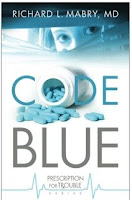
Code Blue (Prescription for Trouble)
Abingdon Press (April 1, 2010)
ABOUT THE AUTHOR:
After his retirement from a distinguished career as a physician and medical educator, Richard turned his talents to non-medical writing. Code Blue is his debut novel, the first of the Prescription For Trouble series, featuring medical suspense. Richard and his wife, Kay, make their home in North Texas, where he continues his struggles to master golf and be the world’s most perfect grandfather.Visit the author's website.
Product Details:
List Price: $13.99
Paperback: 288 pages
Publisher: Abingdon Press (April 1, 2010)
Language: English
ISBN-10: 1426702361
ISBN-13: 978-1426702365
AND NOW...THE FIRST CHAPTER:
The black SUV barreled out of nowhere, its oversized tires straddling the centerline. Cathy jerked the steering wheel to the right and jammed the brake pedal to the floor. Her little Toyota rocked as though flicked by a giant hand before it spun off the narrow country road and hurtled toward the ditch and the peach orchard beyond it.
For a moment Cathy felt the fearful thrill of weightlessness. Then the world turned upside down, and everything went into freeze-frame slow motion.
The floating sensation ended with a jolt. The screech of ripping metal swallowed Cathy’s scream. The deploying airbag struck her face like a fist. The pressure of the shoulder harness took her breath away. The lap belt pressed into her abdomen, and she tasted bile and acid. As her head cleared, she found herself hanging head-down, swaying slightly as the car rocked to a standstill. In the silence that followed, her pulse hammered in her ears like distant, rhythmic thunder.
Cathy realized she was holding her breath. She let out a shuddering sigh, inhaled, and immediately choked on the dust that hung thick in the air. She released her death-grip on the steering wheel and tried to lift her arms. It hurt—it hurt a lot—but they seemed to work. She tilted her head and felt something warm trickle down her face. She tried to wipe it away, but not before a red haze clouded her vision.
She felt a burning sensation, first in her nostrils, then in the back of her throat. Gasoline! Cathy recalled all the crash victims she’d seen in the emergency room—victims who’d survived a car accident only to be engulfed in flames afterward. She had to get out of the car. Now. Her fingers probed for the seatbelt buckle. She found it and pressed the release button. Slowly. Be careful. Don’t fall out of the seat and make matters worse. The belt gave way, and she eased her weight onto her shoulders. She bit her lip from the pain, rolled onto her side, and looked around.
How could she escape? She tried the front doors. Jammed—both of them. She’d been driving with her window partially open, enjoying the brisk autumn air and the parade of orange and yellow trees rolling by in the Texas landscape. There was no way she could wriggle through that small opening. Cathy drew back both feet and kicked hard at the exposed glass. Nothing. She kicked harder. On the third try, the window gave way.
Where was her purse? Never mind. No time. She had to get out. Cathy inched her way through the window, flinching as tiny shards of glass stung her palms and knees. Once free from the car, she lay back on the grass and looked around at what remained of the orchard, blessing the trees that had sacrificed themselves to cushion her car’s landing.
She rose unsteadily to her feet. It seemed as though every bone in her body cried out at the effort. The moment she stood upright the world faded into a gray haze. She slumped to the ground and took a few deep breaths. Her head hurt, her eyes burned, her throat seemed to be closing up. The smell of gasoline cut through her lethargy. She had to get further away from the car. How could she do that, when she couldn’t even stand without passing out?
Cathy saw a peach sapling a few feet away, a tiny survivor amid the ruins. She crawled to the tree, grabbed it, and walked her hands up the trunk until she was almost upright. She clung there, drained by the exertion, until the world stopped spinning.
Something dripped into her eyes and the world turned red. Cathy risked turning loose with one hand and wiped it across her face. Her vision cleared a bit. She regarded the crimson stain on her palm. Good thing she was no stranger to the sight of blood.
Now she was upright, but could she walk? Maybe, if she could stand the pain. She wasn’t sure she could make it more than a step or two, though. A stout limb lying in the debris at her feet caught her eye. It was about four feet long, two inches thick—just the right size. Cathy eased her way down to a crouch, using the sapling for support. She grabbed the limb and, holding it like a staff, managed to stand up. She rested for a moment, then inched her way along the bottom of the ditch, away from the car. When she could no longer smell gasoline and when her aching limbs would carry her no farther, she leaned on her improvised crutch to rest.
Cathy stared at the road above her. The embankment sloped upward in a gentle rise of about six feet. Ordinarily, climbing it would be child’s play for her. But right now she felt like a baby—weak, uncoordinated, and fearful.
Maybe if she rested for a moment on that big rock. She hobbled to it and lowered herself, wincing with each movement. There was no way she could get comfortable—even breathing was painful—but she needed time to think.
Had the SUV really tried to run her off the road? She wanted to believe it was simply an accident, that someone had lost control of his vehicle. Just like she’d wanted to believe that the problems she’d had since she came back home were nothing more than a run of bad luck. Now she had to accept the possibility that someone was making an effort to drive her out of town.
She’d never thought much about the name of her hometown: Dainger, Texas. She vaguely recalled it was named for some settler, long ago forgotten. Now she was thinking the name seemed significant. Danger. Had the problems she’d left behind in Dallas followed her? Or did the roots lie here in Dainger? Possibly. After all, small towns have long memories. Of course, there could be another explanation. . . . No, she couldn’t accept that. Not yet.
Cathy turned to survey the wreckage of her poor little car. She saw wheels silhouetted against the sky, heard the ticking of the cooling motor. Then she picked up new sounds: the roar of a car’s engine, followed by the screech of tires and the chatter of gravel. It could be someone stopping to help. On the other hand, it could be the driver of the SUV coming back to finish the job. She thought of hiding. But where? How?
She watched a white pickup skid to a stop on the shoulder of the road above the wreckage. A car door slammed. A man’s voice called, “Is anyone down there? Are you hurt?”
No chance to get away now. She’d have to take her chances and pray that he was really here to help. Pray? That was a laugh. Cathy had prayed before, prayed hard, all without effect. Why should she expect anything different this time?
“Is someone there? Are you hurt?”
How should she react? Answer or stay quiet? Neither choice seemed good. She tried to clear the dust from her throat, but when she opened her mouth to yell, she could only manage a strangled whisper. “Yes.”
Footsteps crunched on the gravel shoulder above her, and an urgent voice shouted, “Is someone down there? Do you need help?”
“Yes,” she croaked a bit stronger.
“I’m coming down,” he said. “Hang on.”
A head peered over the edge of the embankment, but pulled back before she could get more than a glimpse of him.
In a few seconds, he scrambled down the embankment, skidding in the red clay before he could dig in the heels of his cowboy boots. At the bottom he looked around until he spotted her. He half-ran the last few feet to where she stood swaying on her makeshift crutch.
“Here, let me help you. Can you walk?”
Blood trickled into her eyes again, and even after she wiped it away, it was like looking through crimson gauze. Cathy could make out the man’s outline but not his features. He sounded harmless enough. But she supposed even mass murderers could sound harmless.
She gripped her makeshift staff harder; it might work as a weapon. “I don’t think anything’s broken.” Her voice cracked, and she coughed. “I’m just stunned. If you help me, I think I can move okay.”
He leaned down and Cathy put her left arm on his shoulder. He encircled her waist with his right arm, supporting her so her feet barely touched the ground as they shuffled toward the slope. At the bottom, he turned and swept her into his arms. The move took her by surprise, and she gasped. She felt him stagger a bit on the climb, but in a moment they made it to the top.
Her rescuer freed one hand and thumbed the latch on the passenger side door of his pickup. He turned to bump the door open with his hip, then deposited her gently onto the seat. “Rest there. I’ll call 911.”
Cathy leaned back and tried to calm down. His voice sounded familiar. Was he one of her patients? She swiped the back of her hand across her eyes, but the image remained cloudy.
The man pulled a flip-phone from his pocket and punched in three digits. “There’s been a one-car accident.”
She listened as he described the accident location in detail—a mile south of the Freeman farm, just before the Sandy Creek Bridge. This wasn’t some passer-by. He knew the area.
“I need an ambulance, a fire truck, and someone from the sheriff’s office. Oh, and send a flatbed wrecker. The car looks like it’s totaled.”
“I don’t need an ambulance,” Cathy protested.
He held up a hand and shushed her, something she hadn’t encountered since third grade. “Yes, she seems okay, but I still think they need to hurry.”
Cathy heard a few answering squawks from the phone before the man spoke again. “It’s Will Kennedy. Yes, thanks.”
Will Kennedy? If she hadn’t been sitting down, Cathy might have fallen over. She scrubbed at her eyes and squinted. Will? Yes, it was Will. Now even the shape of his body looked familiar: lean and muscular, just the way he’d been—. No. Don’t go there.
Will ended his call and leaned in through the open pickup door. “They’ll be here in a minute. Hang on.”
He took a clean handkerchief from the hip pocket of his pressed jeans and gently cleaned her face. The white cotton rapidly turned red, and Cathy realized that the blood had not only clouded her vision. It had masked her features.
“Will, don’t you recognize me?”
He stopped, looked at her, and frowned. “Cathy?”
“Yes.” There were so many things to say. She drew in a ragged breath. “Thanks. I appreciate your stopping.”
He gave her the wry grin she remembered so well, and her heart did a flip-flop. “I’d heard you were back in town, and I wondered when you’d get around to talking to me. I just didn’t know it would be like this.” He paused. “And forget about telling me not to have them send an ambulance. I don’t care if you are a doctor now, Cathy Sewell. I won’t turn you loose until another medic checks you.”
Cathy opened her mouth to speak, but Will’s cell phone rang. He answered it and walked away as he talked, while she sat and wondered what would have happened if they’d never turned each other loose in the first place.
* * *
As the ambulance sped toward Summers County General Hospital, Cathy wondered what kind of reception she would get there. Who would be on duty? Would they acknowledge her as a colleague, even though she hadn’t been given privileges yet? When her thoughts turned to recent events, she forced herself to shut down the synapses and put her mind into neutral.
The ambulance rocked to a halt outside the emergency room doors. Despite Cathy’s protestations, the emergency medical technicians kept her strapped securely on the stretcher while they offloaded it. Inside the ER, Cathy finally convinced her guardians to let her transfer to a wheelchair held by a waiting orderly.
“Thanks so much, guys. I’ll be fine. Really.”
At the admitting desk, the clerk looked up from her computer and frowned.
“Cathy?” She flushed. “I . . . I mean, Dr. Sewell?”
“It’s okay, Judy. I was Cathy through twelve years of school. No reason to change.” Cathy looked around. “Who’s the ER doctor on duty?”
“Dr. Patel. He just called in Dr. Bell to see a patient. Dr. Patel thought it might be a possible appendix.” She lowered her voice. “Dr. Bell took one look and made the diagnosis of stomach flu. I couldn’t see the need to call in another doctor for a consultation, but Dr. Patel is so afraid he’ll make a wrong diagnosis.” She pursed her lips as she realized her mistake of complaining about one doctor to another.
“Just be sure Dr. Patel doesn’t hear you say that.” Cathy tried to take the sting out of the words with a wink, but the blood dried around her eyes made it impossible. “Can you call him? I’ve been threatened with dire punishment if I don’t get checked out.”
Judy reached for the phone.
“Don’t bother, Judy. I’ll take care of Dr. Sewell myself.”
Cathy eased her head around to see Marcus Bell standing behind her. He wore khakis and a chocolate-brown golf shirt, covered by an immaculate white coat with his name embroidered over the pocket.
This was a trade Cathy would gladly make—finicky Dr. Patel for superdoc Marcus Bell. In the three years he’d been here, Marcus had built a reputation as an excellent clinician. He was also undoubtedly the best-looking doctor in town.
“Let’s get you into Treatment Room One,” Marcus steered Cathy’s wheelchair away from the desk. “Judy, you can bring me the paperwork when you have it ready. Please ask Marianne to step in and help me for a minute. And page Jerry for me, would you? Thanks.”
Cathy had been in treatment rooms like this many times in several hospitals. Now she noticed how different everything looked when viewed from this perspective. As if the accident and the adrenaline rush that followed hadn’t made her shaky enough, sitting there in a wheelchair emphasized her feeling of helplessness. “I feel so silly,” she said. “Usually I’m on the other end of all this.”
“Well, today you’re not.” Marcus gestured toward the nurse who stood in the doorway. “Let’s get you into a gown. Then we’ll check the extent of the damages.”
Marcus stepped discreetly from the room.
“I’m Marianne,” the nurse said. Then, as though reading Cathy’s mind, she added, “I know it’s hard for a doctor to be a patient. But try to relax. We’ll take good care of you.”
Marianne helped Cathy out of her clothes and into a hospital gown. If Cathy had felt vulnerable before this, the added factor of being in a garment that had so many openings closed only by drawstrings tripled the feeling. The nurse eased Cathy onto the examining table, covered her with a clean sheet, and called Marcus back into the room.
“Now, Cathy, the first thing I want to do is have a closer look at that cut on your head.” Marcus slipped on a pair of latex gloves and probed the wound.
Cathy flinched. “How does it look?”
“Not too bad. One laceration about three or four centimeters long in the frontal area. Not too deep. The bleeding’s almost stopped now. We’ll get some skull films, then I’ll suture it.” He wound a soft gauze bandage around her head and taped it.
Marcus flipped off his gloves and picked up the clipboard that Cathy knew held the beginnings of her chart. “Why don’t you tell me what happened?”
At first, Cathy laid out the details of the accident and her injuries in terse clinical language, as though presenting a case to an attending physician at Grand Rounds. She did fine until she realized how close she’d come to being killed, apparently by someone who meant to do just that. There were a couple of strangled hiccups, then a few muffled sobs, before the calm physician turned into a blubbering girl. “I’m . . . I’m sorry.” She reached for a tissue from the box Marcus held out.
“No problem. If you weren’t upset by all that, you wouldn’t be normal.” Marcus took an ophthalmoscope from the wall rack and shined its light into her eyes. “How’s your vision?”
“Still a little fuzzy—some halos around lights. I figured it was from the blood running into my eyes.”
He put down the instrument and rummaged in the drug cabinet. “Let’s wash out your eyes. I don’t want you to get a chemical keratitis from the powder on the air bag. I’ll give you some eye drops, but if your vision gets worse or doesn’t clear in a day or so, I want you to see an ophthalmologist.”
“Oh, right.” The fact that she hadn’t thought of that underscored to Cathy how shaken she still was.
“Now, let’s see what else might be injured.” Marcus took her left wrist and gently probed with his fingers. Apparently satisfied, he proceeded up along the bones of the arm. His touch was gentle, yet firm, and Cathy found it somehow reassuring. “We’ll need some X-rays. I want you to help me figure out the right parts.”
“I can’t help you much. I’m hurting pretty much everywhere,” Cathy said. “But, I haven’t felt any bones grating. I think I’m just banged up.”
Marcus turned his attention to her right arm. He paused in his prodding long enough to touch her chin and raise her head until their eyes met. “You’re like all of us. You think that because you’re a doctor you can’t be hurt or sick.”
“That’s not true. I don’t— Ow!” His hand on the point of her right shoulder sent a flash of pain along her collarbone.
“That’s more like it. We’ll get an X-ray of that shoulder and your clavicle. Seatbelt injuries do that sometimes. Now see if you can finish telling me what happened.”
This time she got through the story without tearing up, although Marcus’s efforts to find something broken or dislocated brought forth a number of additional flinches and exclamations.
“I really do think I’m fine except for some bruises,” she concluded.
“Really?”
“Okay, I’m also scared. And a little bit mad.”
A tinny voice over the intercom interrupted her. “Dr. Bell, is Marianne still in there?”
“I’m here,” the nurse replied.
“Can you help us out? There’s a pedi patient in Treatment Room Two with suspected meningitis. They’re about to do a spinal tap.”
“Go ahead,” Marcus said. “We can take it from here.”
No sooner had the nurse closed the door than there was a firm tap on it.
“Jerry?” Marcus called.
“Yes, sir.”
“Come in.”
The door creaked open, and Cathy turned. The pain that coursed through her neck made her regret the decision. A man in starched, immaculate whites strode into the room and stopped at an easy parade rest. A smattering of gray at the temples softened the red in his buzz-cut hair.
Marcus did the honors. “Dr. Sewell, this is Jerry O’Neal. Jerry retired after twenty years as a Marine corpsman, and he’s now the senior radiology technician at Summers County General. He probably knows as much medicine as you and I put together, but he’s too polite to let it show.”
“Pleasure to meet you, Doctor,” Jerry said.
Marcus handed the clipboard chart to Jerry. “Dr. Sewell’s been in an auto accident. She has a scalp laceration I’ll need to suture, but first, would you get a skull series, films of the right shoulder and clavicle?” He thought a bit. “Right knee. Right lower leg. While we’re at it, better do a C-spine too.”
“Yes, sir,” Jerry said. “Is that all?”
Marcus looked back at Cathy. “If you catch her rubbing anything else, shoot it. Call me when you’ve got the films ready.”
Cathy half- expected Jerry to salute Marcus. Instead, he nodded silently before helping her off the exam table and into a wheelchair.
“Don’t worry, Dr. Sewell. You’re in good hands.”
She tried to relax and take Jerry at his word. “Why haven’t I seen you around before this?”
Jerry fiddled with some dials. “I work weekdays as a trouble-shooter for an X-ray equipment company in Dallas. I’m only here on weekends. It fills the empty hours.”
That’s why I was taking a drive on Saturday afternoon. Filling the empty hours. That started a chain of thought Cathy didn’t want to pursue. Instead, she concentrated on getting through the next few minutes.
The X-rays took less time and caused less discomfort than Cathy expected. She could see why Marcus thought so highly of Jerry. Soon she was back in the treatment room, lying on the examination table. Jerry put up two of the X-rays on the wall view box and stacked the others neatly on the metal table beneath it.
“I’ll get Dr. Bell now. Will you be okay here for a minute?”
Cathy assured Jerry that she was fine, although she finally realized how many bumps and bruises she’d accumulated in the crash. Every movement seemed to make something else hurt.
When she thought about what came next, her anxiety kicked into high gear. Would Marcus have to shave her scalp before placing the stitches? She recalled her own experiences suturing scalp lacerations in the Parkland Hospital Emergency Room. Maybe it was a woman thing, but she’d felt sorry for those patients, walking out with a shaved spot on their head, a bald patch that was sometimes the size of a drink coaster. She hated the prospect of facing her patients on Monday in that condition. Truthfully, she even hated the prospect of looking at herself in the mirror. She was thinking about wigs when Marcus reentered the room.
“Let’s see what we’ve got.” He stepped to the view box and ran through the X-rays. “Skull series looks fine. . . . Neck is good. . . . Shoulder looks okay. . . .The clavicle isn’t fractured. . . . You are one lucky woman. Looks like all I have to do is suture that scalp laceration.”
Cathy was surprised when Marcus didn’t call for help, but rather assembled the necessary instruments and equipment himself. When he slipped his gloves on, she closed her eyes and gritted her teeth. The fact that she’d been on the other end of this procedure hundreds of times just made her dread it more.
Marcus’s touch was gentle as he cleaned the wound. Soon she felt the sting of a local anesthetic injection. After that, there was nothing except an occasional tug as he sutured.
Cathy processed what she’d just felt. “You didn’t shave my scalp.”
“Now why would I want to mar that natural beauty of yours? I didn’t paint the wound orange with Betadine, either. I used a clear antiseptic to prep the area and KY jelly to plaster the hair down out of my way. The sutures are clear nylon that won’t be noticeable in your blonde hair. When I’m finished, I’ll paint some collodion over the wound to protect it. In the morning, clean the area with a damp cloth, brush your hair over it, and no one will know the difference.”
Cathy couldn’t believe what she’d heard. “Natural beauty?” This was certainly at odds with what she’d been told about Marcus Bell. Since the death of his wife, Marcus apparently wanted nothing to do with women. Rumor had it he’d turned aside the advances of most of the single women in Dainger. Was he flirting with her now? Or was this simply his bedside manner?
Marcus snapped off his gloves and tossed them in the bucket at the end of the table. “See me in a week to remove the stitches—unless you want to stand on a box and look down on the top of your own head to remove them yourself.”
“Okay, I get it. I’ll stop being my own doctor,” she said.
“How about something for the pain?”
“I think I’ll be okay.”
“Tetanus shot?”
“I’m current.”
“Then how about dinner with me next Thursday?”
Once more, Cathy felt her head spin, but this time it had nothing to do with tumbling. about in a runaway auto.
* * *
Cathy had always dreaded Monday mornings, but none so much as this one. Today it was time to show her face to the world.
She took one last look in the mirror. Cathy had figured that her fair complexion would make her bruises show up like tire tracks on fresh snow, but the judicious application of some Covermark had done its job well. The redness she’d noticed in her eyes two days ago had responded well to the eye drops Marcus prescribed. And, true to his prediction, she’d been able to style her hair so that the blonde strands almost hid the stitches in her scalp. A little more lipstick and blusher than usual, drawing attention to her face instead of her hair, and maybe she could fake her way through the day.
No matter how successful she’d been in covering the outward signs of the accident, it was still impossible for her to move without aches and pains. She popped a couple of Extra Strength Tylenol, washed them down with the remnants of her second cup of coffee, and headed out the door to face another week. If the medication kicked in soon, maybe Jane wouldn’t notice that Cathy moved like an old woman. Maybe Jane hadn’t heard the news about the accident. Yeah, and maybe the President would call today and invite Cathy to dinner at the White House.
Cathy tried to sneak in the back door, but Jane’s hearing was awfully good for a woman her age. She met Cathy at the door to her office, clucking like a mother hen and shaking her head. “Dr. Sewell, what happened to you?”
What a break it had been for her when Jane—a trim, silver-haired grandmother with a sassy twinkle in her eye—answered her ad for a combination office nurse and secretary. She’d helped Cathy set up the office, given her advice on business, and provided a sympathetic ear on more occasions than she could count.
Cathy recognized Jane’s question as rhetorical. Having grown up in Dainger, Cathy knew how quickly news spread in her hometown. She’d bet that Jane had known about the accident before Cathy had cleared the emergency room doors on Saturday. By now, probably everyone in town knew.
“I was out for a ride in the country. I needed to relax and clear my mind. Then someone ran me off the road out near Big Sandy Creek. My car went out of control, flipped, and took out a row of Seth Johnson’s peach trees.” Cathy winced as she dropped her purse into the bottom drawer of her desk. “Dr. Bell sutured a laceration on my scalp.”
“Any other injuries? Do we need to cancel today’s patients?”
Cathy shook her head, aggravating a headache that the Tylenol had only dulled. “Other than the fact that I feel like I’ve just finished a week of two-a-day practices with the Dallas Cowboys, I’m okay.”
“It’s good that you have a nice light schedule today. You can take it easy.”
Cathy frowned. A “nice light schedule” for a doctor just getting started as a family practitioner wasn’t exactly the stuff she dreamed about. She needed patients. The money from the bank loan was about gone, and her income stream was anything but impressive. But, she’d do the best she could. Anything had to beat living in Dallas, knowing she might run into Robert.
Speak of the devil. Cathy actually shuddered when she saw the return address on the envelope sitting in the middle of her desk: Robert Edward Newell, M.D.
She clamped her jaws shut, snatched up a brass letter opener, and ripped open the envelope. Inside were two newspaper clippings and a few words scribbled on a piece of white notepad with an ad for a hypertension drug at the top of the page. The first clipping announced the engagement of Miss Laura Lynn Hunt, daughter of Dr. Earl and Mrs. Betty Hunt, to Dr. Robert Edward Newell. The second featured a photo of Laura Lynn and Robert, she in a high couture evening gown, he in a perfectly fitting tux, arriving at the Terpsichorean Ball. The note was brief and to the point: “See what you’ve missed?” No signature. Just a reminder, one that made her grit her teeth until her jaws ached. Leave it to Robert to rub salt in her wounds.
She forced herself to sit quietly and breathe deeply, until the knot in her throat loosened. Then she wadded the clippings and note into a tight ball, which she consigned to the wastebasket with as much force as she could muster.
No use rethinking the past. Time to get on with her life. “Jane,” she called. “May I have the charts for today’s patients? I want to go over them.”
Jane returned and deposited a pitifully small stack of thin charts on Cathy’s desk. The look in Jane’s eyes said it all. Sorry there aren’t more. Sorry you’re hurting. Sorry.
Cathy picked up the top chart but didn’t open it. “Do you think I made a mistake coming here to practice?”
Jane eased into one of the patient chairs across the desk from Cathy. “Why would you ask that?”
“I applied at three banks before I got a loan. When I mention to other doctors that I’m taking new patients, they get this embarrassed look and mumble something about keeping that in mind, but they never make any referrals. Several of my patients tell me they’ve heard stories around town that make them wonder about my capabilities. And my privileges at the hospital have been stuck in committee for over a month now.” Cathy pointed to the stitches in her scalp. “Now the situation seems to be escalating.”
“You mean the accident on Saturday?”
“It was no accident. I’m convinced that someone ran me off the road and intended to kill me.”
“Did you report it?” Jane asked.
“Yes, but fat lot of good it did. If Will Kennedy hadn’t insisted, I think the deputy who came out to investigate the accident would have written the whole thing off as careless driving on my part.” Cathy grimaced. “Of course, he may do that anyway.”
“What was Will Kennedy doing there?”
“He came along right after the wreck. When I couldn’t manage under my own power, Will carried me up the embankment. Then he insisted I go to the emergency room, and when they were loading me into the ambulance he slipped his card into my hand and whispered, ‘Please call me. I want to make sure you’re okay.’” Cathy pulled a business card from the pocket of her skirt, smoothed the wrinkles from it, and put it under the corner of her blotter.
“Did you phone him?”
Cathy shook her head. “I started to, but I couldn’t. I’m not ready to get close to any man. Not Will Kennedy. Not Marcus Bell. Not Robert Newell.” She took in a deep breath through her nose and let it out through pursed lips. “Especially not Robert Newell.”
“Who is—?”
Before Jane could finish, Cathy spun around in her chair and pulled a book at random from the shelf behind her. “Not now. Please. I need to look up something before I see my first patient.” She paged through the book, but none of the words registered.
Jane’s voice from behind her made Cathy close the book. “Dr. Sewell, you asked me a question. Let me answer it before I go. I don’t know if someone’s really making an effort to run you off. I’ve heard some of those rumors. They’re always anonymous, like ‘Somebody told me that Dr. Sewell’s not a good doctor.’ Or ‘I heard Dr. Sewell came back to Dainger because she couldn’t make it in Dallas.’ You have to ignore the gossip and rumors. They’re part of living here.”
Cathy swiveled back to face Jane. “I thought it would be easier to get my practice started in my hometown.”
“It might be, except that people here will compare you to your daddy, who was the best surgeon Dainger ever saw. In that situation a young, female doctor will come up short, no matter how qualified she is.”
Cathy tossed the book on her desk and held her hands up, palms forward. “If someone wants to get rid of me, they’re close to succeeding. I don’t know how much longer I can go on.”
“You’re a fighter, and I’m right here with you. Just stick with it.” Jane turned and walked toward the doorway.
“Thanks. I appreciate it.”
Jane stopped and faced Cathy once more. “Have you been out to visit your folks?”
“It won’t do any good. There’s nothing for me there. I don’t have anything to say.”
Jane shook her head. “Sometimes you don’t have to say anything. Sometimes you simply have to make the effort and go. It’s the only way you’ll ever put all that behind you.”
For a moment Cathy felt the fearful thrill of weightlessness. Then the world turned upside down, and everything went into freeze-frame slow motion.
The floating sensation ended with a jolt. The screech of ripping metal swallowed Cathy’s scream. The deploying airbag struck her face like a fist. The pressure of the shoulder harness took her breath away. The lap belt pressed into her abdomen, and she tasted bile and acid. As her head cleared, she found herself hanging head-down, swaying slightly as the car rocked to a standstill. In the silence that followed, her pulse hammered in her ears like distant, rhythmic thunder.
Cathy realized she was holding her breath. She let out a shuddering sigh, inhaled, and immediately choked on the dust that hung thick in the air. She released her death-grip on the steering wheel and tried to lift her arms. It hurt—it hurt a lot—but they seemed to work. She tilted her head and felt something warm trickle down her face. She tried to wipe it away, but not before a red haze clouded her vision.
She felt a burning sensation, first in her nostrils, then in the back of her throat. Gasoline! Cathy recalled all the crash victims she’d seen in the emergency room—victims who’d survived a car accident only to be engulfed in flames afterward. She had to get out of the car. Now. Her fingers probed for the seatbelt buckle. She found it and pressed the release button. Slowly. Be careful. Don’t fall out of the seat and make matters worse. The belt gave way, and she eased her weight onto her shoulders. She bit her lip from the pain, rolled onto her side, and looked around.
How could she escape? She tried the front doors. Jammed—both of them. She’d been driving with her window partially open, enjoying the brisk autumn air and the parade of orange and yellow trees rolling by in the Texas landscape. There was no way she could wriggle through that small opening. Cathy drew back both feet and kicked hard at the exposed glass. Nothing. She kicked harder. On the third try, the window gave way.
Where was her purse? Never mind. No time. She had to get out. Cathy inched her way through the window, flinching as tiny shards of glass stung her palms and knees. Once free from the car, she lay back on the grass and looked around at what remained of the orchard, blessing the trees that had sacrificed themselves to cushion her car’s landing.
She rose unsteadily to her feet. It seemed as though every bone in her body cried out at the effort. The moment she stood upright the world faded into a gray haze. She slumped to the ground and took a few deep breaths. Her head hurt, her eyes burned, her throat seemed to be closing up. The smell of gasoline cut through her lethargy. She had to get further away from the car. How could she do that, when she couldn’t even stand without passing out?
Cathy saw a peach sapling a few feet away, a tiny survivor amid the ruins. She crawled to the tree, grabbed it, and walked her hands up the trunk until she was almost upright. She clung there, drained by the exertion, until the world stopped spinning.
Something dripped into her eyes and the world turned red. Cathy risked turning loose with one hand and wiped it across her face. Her vision cleared a bit. She regarded the crimson stain on her palm. Good thing she was no stranger to the sight of blood.
Now she was upright, but could she walk? Maybe, if she could stand the pain. She wasn’t sure she could make it more than a step or two, though. A stout limb lying in the debris at her feet caught her eye. It was about four feet long, two inches thick—just the right size. Cathy eased her way down to a crouch, using the sapling for support. She grabbed the limb and, holding it like a staff, managed to stand up. She rested for a moment, then inched her way along the bottom of the ditch, away from the car. When she could no longer smell gasoline and when her aching limbs would carry her no farther, she leaned on her improvised crutch to rest.
Cathy stared at the road above her. The embankment sloped upward in a gentle rise of about six feet. Ordinarily, climbing it would be child’s play for her. But right now she felt like a baby—weak, uncoordinated, and fearful.
Maybe if she rested for a moment on that big rock. She hobbled to it and lowered herself, wincing with each movement. There was no way she could get comfortable—even breathing was painful—but she needed time to think.
Had the SUV really tried to run her off the road? She wanted to believe it was simply an accident, that someone had lost control of his vehicle. Just like she’d wanted to believe that the problems she’d had since she came back home were nothing more than a run of bad luck. Now she had to accept the possibility that someone was making an effort to drive her out of town.
She’d never thought much about the name of her hometown: Dainger, Texas. She vaguely recalled it was named for some settler, long ago forgotten. Now she was thinking the name seemed significant. Danger. Had the problems she’d left behind in Dallas followed her? Or did the roots lie here in Dainger? Possibly. After all, small towns have long memories. Of course, there could be another explanation. . . . No, she couldn’t accept that. Not yet.
Cathy turned to survey the wreckage of her poor little car. She saw wheels silhouetted against the sky, heard the ticking of the cooling motor. Then she picked up new sounds: the roar of a car’s engine, followed by the screech of tires and the chatter of gravel. It could be someone stopping to help. On the other hand, it could be the driver of the SUV coming back to finish the job. She thought of hiding. But where? How?
She watched a white pickup skid to a stop on the shoulder of the road above the wreckage. A car door slammed. A man’s voice called, “Is anyone down there? Are you hurt?”
No chance to get away now. She’d have to take her chances and pray that he was really here to help. Pray? That was a laugh. Cathy had prayed before, prayed hard, all without effect. Why should she expect anything different this time?
“Is someone there? Are you hurt?”
How should she react? Answer or stay quiet? Neither choice seemed good. She tried to clear the dust from her throat, but when she opened her mouth to yell, she could only manage a strangled whisper. “Yes.”
Footsteps crunched on the gravel shoulder above her, and an urgent voice shouted, “Is someone down there? Do you need help?”
“Yes,” she croaked a bit stronger.
“I’m coming down,” he said. “Hang on.”
A head peered over the edge of the embankment, but pulled back before she could get more than a glimpse of him.
In a few seconds, he scrambled down the embankment, skidding in the red clay before he could dig in the heels of his cowboy boots. At the bottom he looked around until he spotted her. He half-ran the last few feet to where she stood swaying on her makeshift crutch.
“Here, let me help you. Can you walk?”
Blood trickled into her eyes again, and even after she wiped it away, it was like looking through crimson gauze. Cathy could make out the man’s outline but not his features. He sounded harmless enough. But she supposed even mass murderers could sound harmless.
She gripped her makeshift staff harder; it might work as a weapon. “I don’t think anything’s broken.” Her voice cracked, and she coughed. “I’m just stunned. If you help me, I think I can move okay.”
He leaned down and Cathy put her left arm on his shoulder. He encircled her waist with his right arm, supporting her so her feet barely touched the ground as they shuffled toward the slope. At the bottom, he turned and swept her into his arms. The move took her by surprise, and she gasped. She felt him stagger a bit on the climb, but in a moment they made it to the top.
Her rescuer freed one hand and thumbed the latch on the passenger side door of his pickup. He turned to bump the door open with his hip, then deposited her gently onto the seat. “Rest there. I’ll call 911.”
Cathy leaned back and tried to calm down. His voice sounded familiar. Was he one of her patients? She swiped the back of her hand across her eyes, but the image remained cloudy.
The man pulled a flip-phone from his pocket and punched in three digits. “There’s been a one-car accident.”
She listened as he described the accident location in detail—a mile south of the Freeman farm, just before the Sandy Creek Bridge. This wasn’t some passer-by. He knew the area.
“I need an ambulance, a fire truck, and someone from the sheriff’s office. Oh, and send a flatbed wrecker. The car looks like it’s totaled.”
“I don’t need an ambulance,” Cathy protested.
He held up a hand and shushed her, something she hadn’t encountered since third grade. “Yes, she seems okay, but I still think they need to hurry.”
Cathy heard a few answering squawks from the phone before the man spoke again. “It’s Will Kennedy. Yes, thanks.”
Will Kennedy? If she hadn’t been sitting down, Cathy might have fallen over. She scrubbed at her eyes and squinted. Will? Yes, it was Will. Now even the shape of his body looked familiar: lean and muscular, just the way he’d been—. No. Don’t go there.
Will ended his call and leaned in through the open pickup door. “They’ll be here in a minute. Hang on.”
He took a clean handkerchief from the hip pocket of his pressed jeans and gently cleaned her face. The white cotton rapidly turned red, and Cathy realized that the blood had not only clouded her vision. It had masked her features.
“Will, don’t you recognize me?”
He stopped, looked at her, and frowned. “Cathy?”
“Yes.” There were so many things to say. She drew in a ragged breath. “Thanks. I appreciate your stopping.”
He gave her the wry grin she remembered so well, and her heart did a flip-flop. “I’d heard you were back in town, and I wondered when you’d get around to talking to me. I just didn’t know it would be like this.” He paused. “And forget about telling me not to have them send an ambulance. I don’t care if you are a doctor now, Cathy Sewell. I won’t turn you loose until another medic checks you.”
Cathy opened her mouth to speak, but Will’s cell phone rang. He answered it and walked away as he talked, while she sat and wondered what would have happened if they’d never turned each other loose in the first place.
* * *
As the ambulance sped toward Summers County General Hospital, Cathy wondered what kind of reception she would get there. Who would be on duty? Would they acknowledge her as a colleague, even though she hadn’t been given privileges yet? When her thoughts turned to recent events, she forced herself to shut down the synapses and put her mind into neutral.
The ambulance rocked to a halt outside the emergency room doors. Despite Cathy’s protestations, the emergency medical technicians kept her strapped securely on the stretcher while they offloaded it. Inside the ER, Cathy finally convinced her guardians to let her transfer to a wheelchair held by a waiting orderly.
“Thanks so much, guys. I’ll be fine. Really.”
At the admitting desk, the clerk looked up from her computer and frowned.
“Cathy?” She flushed. “I . . . I mean, Dr. Sewell?”
“It’s okay, Judy. I was Cathy through twelve years of school. No reason to change.” Cathy looked around. “Who’s the ER doctor on duty?”
“Dr. Patel. He just called in Dr. Bell to see a patient. Dr. Patel thought it might be a possible appendix.” She lowered her voice. “Dr. Bell took one look and made the diagnosis of stomach flu. I couldn’t see the need to call in another doctor for a consultation, but Dr. Patel is so afraid he’ll make a wrong diagnosis.” She pursed her lips as she realized her mistake of complaining about one doctor to another.
“Just be sure Dr. Patel doesn’t hear you say that.” Cathy tried to take the sting out of the words with a wink, but the blood dried around her eyes made it impossible. “Can you call him? I’ve been threatened with dire punishment if I don’t get checked out.”
Judy reached for the phone.
“Don’t bother, Judy. I’ll take care of Dr. Sewell myself.”
Cathy eased her head around to see Marcus Bell standing behind her. He wore khakis and a chocolate-brown golf shirt, covered by an immaculate white coat with his name embroidered over the pocket.
This was a trade Cathy would gladly make—finicky Dr. Patel for superdoc Marcus Bell. In the three years he’d been here, Marcus had built a reputation as an excellent clinician. He was also undoubtedly the best-looking doctor in town.
“Let’s get you into Treatment Room One,” Marcus steered Cathy’s wheelchair away from the desk. “Judy, you can bring me the paperwork when you have it ready. Please ask Marianne to step in and help me for a minute. And page Jerry for me, would you? Thanks.”
Cathy had been in treatment rooms like this many times in several hospitals. Now she noticed how different everything looked when viewed from this perspective. As if the accident and the adrenaline rush that followed hadn’t made her shaky enough, sitting there in a wheelchair emphasized her feeling of helplessness. “I feel so silly,” she said. “Usually I’m on the other end of all this.”
“Well, today you’re not.” Marcus gestured toward the nurse who stood in the doorway. “Let’s get you into a gown. Then we’ll check the extent of the damages.”
Marcus stepped discreetly from the room.
“I’m Marianne,” the nurse said. Then, as though reading Cathy’s mind, she added, “I know it’s hard for a doctor to be a patient. But try to relax. We’ll take good care of you.”
Marianne helped Cathy out of her clothes and into a hospital gown. If Cathy had felt vulnerable before this, the added factor of being in a garment that had so many openings closed only by drawstrings tripled the feeling. The nurse eased Cathy onto the examining table, covered her with a clean sheet, and called Marcus back into the room.
“Now, Cathy, the first thing I want to do is have a closer look at that cut on your head.” Marcus slipped on a pair of latex gloves and probed the wound.
Cathy flinched. “How does it look?”
“Not too bad. One laceration about three or four centimeters long in the frontal area. Not too deep. The bleeding’s almost stopped now. We’ll get some skull films, then I’ll suture it.” He wound a soft gauze bandage around her head and taped it.
Marcus flipped off his gloves and picked up the clipboard that Cathy knew held the beginnings of her chart. “Why don’t you tell me what happened?”
At first, Cathy laid out the details of the accident and her injuries in terse clinical language, as though presenting a case to an attending physician at Grand Rounds. She did fine until she realized how close she’d come to being killed, apparently by someone who meant to do just that. There were a couple of strangled hiccups, then a few muffled sobs, before the calm physician turned into a blubbering girl. “I’m . . . I’m sorry.” She reached for a tissue from the box Marcus held out.
“No problem. If you weren’t upset by all that, you wouldn’t be normal.” Marcus took an ophthalmoscope from the wall rack and shined its light into her eyes. “How’s your vision?”
“Still a little fuzzy—some halos around lights. I figured it was from the blood running into my eyes.”
He put down the instrument and rummaged in the drug cabinet. “Let’s wash out your eyes. I don’t want you to get a chemical keratitis from the powder on the air bag. I’ll give you some eye drops, but if your vision gets worse or doesn’t clear in a day or so, I want you to see an ophthalmologist.”
“Oh, right.” The fact that she hadn’t thought of that underscored to Cathy how shaken she still was.
“Now, let’s see what else might be injured.” Marcus took her left wrist and gently probed with his fingers. Apparently satisfied, he proceeded up along the bones of the arm. His touch was gentle, yet firm, and Cathy found it somehow reassuring. “We’ll need some X-rays. I want you to help me figure out the right parts.”
“I can’t help you much. I’m hurting pretty much everywhere,” Cathy said. “But, I haven’t felt any bones grating. I think I’m just banged up.”
Marcus turned his attention to her right arm. He paused in his prodding long enough to touch her chin and raise her head until their eyes met. “You’re like all of us. You think that because you’re a doctor you can’t be hurt or sick.”
“That’s not true. I don’t— Ow!” His hand on the point of her right shoulder sent a flash of pain along her collarbone.
“That’s more like it. We’ll get an X-ray of that shoulder and your clavicle. Seatbelt injuries do that sometimes. Now see if you can finish telling me what happened.”
This time she got through the story without tearing up, although Marcus’s efforts to find something broken or dislocated brought forth a number of additional flinches and exclamations.
“I really do think I’m fine except for some bruises,” she concluded.
“Really?”
“Okay, I’m also scared. And a little bit mad.”
A tinny voice over the intercom interrupted her. “Dr. Bell, is Marianne still in there?”
“I’m here,” the nurse replied.
“Can you help us out? There’s a pedi patient in Treatment Room Two with suspected meningitis. They’re about to do a spinal tap.”
“Go ahead,” Marcus said. “We can take it from here.”
No sooner had the nurse closed the door than there was a firm tap on it.
“Jerry?” Marcus called.
“Yes, sir.”
“Come in.”
The door creaked open, and Cathy turned. The pain that coursed through her neck made her regret the decision. A man in starched, immaculate whites strode into the room and stopped at an easy parade rest. A smattering of gray at the temples softened the red in his buzz-cut hair.
Marcus did the honors. “Dr. Sewell, this is Jerry O’Neal. Jerry retired after twenty years as a Marine corpsman, and he’s now the senior radiology technician at Summers County General. He probably knows as much medicine as you and I put together, but he’s too polite to let it show.”
“Pleasure to meet you, Doctor,” Jerry said.
Marcus handed the clipboard chart to Jerry. “Dr. Sewell’s been in an auto accident. She has a scalp laceration I’ll need to suture, but first, would you get a skull series, films of the right shoulder and clavicle?” He thought a bit. “Right knee. Right lower leg. While we’re at it, better do a C-spine too.”
“Yes, sir,” Jerry said. “Is that all?”
Marcus looked back at Cathy. “If you catch her rubbing anything else, shoot it. Call me when you’ve got the films ready.”
Cathy half- expected Jerry to salute Marcus. Instead, he nodded silently before helping her off the exam table and into a wheelchair.
“Don’t worry, Dr. Sewell. You’re in good hands.”
She tried to relax and take Jerry at his word. “Why haven’t I seen you around before this?”
Jerry fiddled with some dials. “I work weekdays as a trouble-shooter for an X-ray equipment company in Dallas. I’m only here on weekends. It fills the empty hours.”
That’s why I was taking a drive on Saturday afternoon. Filling the empty hours. That started a chain of thought Cathy didn’t want to pursue. Instead, she concentrated on getting through the next few minutes.
The X-rays took less time and caused less discomfort than Cathy expected. She could see why Marcus thought so highly of Jerry. Soon she was back in the treatment room, lying on the examination table. Jerry put up two of the X-rays on the wall view box and stacked the others neatly on the metal table beneath it.
“I’ll get Dr. Bell now. Will you be okay here for a minute?”
Cathy assured Jerry that she was fine, although she finally realized how many bumps and bruises she’d accumulated in the crash. Every movement seemed to make something else hurt.
When she thought about what came next, her anxiety kicked into high gear. Would Marcus have to shave her scalp before placing the stitches? She recalled her own experiences suturing scalp lacerations in the Parkland Hospital Emergency Room. Maybe it was a woman thing, but she’d felt sorry for those patients, walking out with a shaved spot on their head, a bald patch that was sometimes the size of a drink coaster. She hated the prospect of facing her patients on Monday in that condition. Truthfully, she even hated the prospect of looking at herself in the mirror. She was thinking about wigs when Marcus reentered the room.
“Let’s see what we’ve got.” He stepped to the view box and ran through the X-rays. “Skull series looks fine. . . . Neck is good. . . . Shoulder looks okay. . . .The clavicle isn’t fractured. . . . You are one lucky woman. Looks like all I have to do is suture that scalp laceration.”
Cathy was surprised when Marcus didn’t call for help, but rather assembled the necessary instruments and equipment himself. When he slipped his gloves on, she closed her eyes and gritted her teeth. The fact that she’d been on the other end of this procedure hundreds of times just made her dread it more.
Marcus’s touch was gentle as he cleaned the wound. Soon she felt the sting of a local anesthetic injection. After that, there was nothing except an occasional tug as he sutured.
Cathy processed what she’d just felt. “You didn’t shave my scalp.”
“Now why would I want to mar that natural beauty of yours? I didn’t paint the wound orange with Betadine, either. I used a clear antiseptic to prep the area and KY jelly to plaster the hair down out of my way. The sutures are clear nylon that won’t be noticeable in your blonde hair. When I’m finished, I’ll paint some collodion over the wound to protect it. In the morning, clean the area with a damp cloth, brush your hair over it, and no one will know the difference.”
Cathy couldn’t believe what she’d heard. “Natural beauty?” This was certainly at odds with what she’d been told about Marcus Bell. Since the death of his wife, Marcus apparently wanted nothing to do with women. Rumor had it he’d turned aside the advances of most of the single women in Dainger. Was he flirting with her now? Or was this simply his bedside manner?
Marcus snapped off his gloves and tossed them in the bucket at the end of the table. “See me in a week to remove the stitches—unless you want to stand on a box and look down on the top of your own head to remove them yourself.”
“Okay, I get it. I’ll stop being my own doctor,” she said.
“How about something for the pain?”
“I think I’ll be okay.”
“Tetanus shot?”
“I’m current.”
“Then how about dinner with me next Thursday?”
Once more, Cathy felt her head spin, but this time it had nothing to do with tumbling. about in a runaway auto.
* * *
Cathy had always dreaded Monday mornings, but none so much as this one. Today it was time to show her face to the world.
She took one last look in the mirror. Cathy had figured that her fair complexion would make her bruises show up like tire tracks on fresh snow, but the judicious application of some Covermark had done its job well. The redness she’d noticed in her eyes two days ago had responded well to the eye drops Marcus prescribed. And, true to his prediction, she’d been able to style her hair so that the blonde strands almost hid the stitches in her scalp. A little more lipstick and blusher than usual, drawing attention to her face instead of her hair, and maybe she could fake her way through the day.
No matter how successful she’d been in covering the outward signs of the accident, it was still impossible for her to move without aches and pains. She popped a couple of Extra Strength Tylenol, washed them down with the remnants of her second cup of coffee, and headed out the door to face another week. If the medication kicked in soon, maybe Jane wouldn’t notice that Cathy moved like an old woman. Maybe Jane hadn’t heard the news about the accident. Yeah, and maybe the President would call today and invite Cathy to dinner at the White House.
Cathy tried to sneak in the back door, but Jane’s hearing was awfully good for a woman her age. She met Cathy at the door to her office, clucking like a mother hen and shaking her head. “Dr. Sewell, what happened to you?”
What a break it had been for her when Jane—a trim, silver-haired grandmother with a sassy twinkle in her eye—answered her ad for a combination office nurse and secretary. She’d helped Cathy set up the office, given her advice on business, and provided a sympathetic ear on more occasions than she could count.
Cathy recognized Jane’s question as rhetorical. Having grown up in Dainger, Cathy knew how quickly news spread in her hometown. She’d bet that Jane had known about the accident before Cathy had cleared the emergency room doors on Saturday. By now, probably everyone in town knew.
“I was out for a ride in the country. I needed to relax and clear my mind. Then someone ran me off the road out near Big Sandy Creek. My car went out of control, flipped, and took out a row of Seth Johnson’s peach trees.” Cathy winced as she dropped her purse into the bottom drawer of her desk. “Dr. Bell sutured a laceration on my scalp.”
“Any other injuries? Do we need to cancel today’s patients?”
Cathy shook her head, aggravating a headache that the Tylenol had only dulled. “Other than the fact that I feel like I’ve just finished a week of two-a-day practices with the Dallas Cowboys, I’m okay.”
“It’s good that you have a nice light schedule today. You can take it easy.”
Cathy frowned. A “nice light schedule” for a doctor just getting started as a family practitioner wasn’t exactly the stuff she dreamed about. She needed patients. The money from the bank loan was about gone, and her income stream was anything but impressive. But, she’d do the best she could. Anything had to beat living in Dallas, knowing she might run into Robert.
Speak of the devil. Cathy actually shuddered when she saw the return address on the envelope sitting in the middle of her desk: Robert Edward Newell, M.D.
She clamped her jaws shut, snatched up a brass letter opener, and ripped open the envelope. Inside were two newspaper clippings and a few words scribbled on a piece of white notepad with an ad for a hypertension drug at the top of the page. The first clipping announced the engagement of Miss Laura Lynn Hunt, daughter of Dr. Earl and Mrs. Betty Hunt, to Dr. Robert Edward Newell. The second featured a photo of Laura Lynn and Robert, she in a high couture evening gown, he in a perfectly fitting tux, arriving at the Terpsichorean Ball. The note was brief and to the point: “See what you’ve missed?” No signature. Just a reminder, one that made her grit her teeth until her jaws ached. Leave it to Robert to rub salt in her wounds.
She forced herself to sit quietly and breathe deeply, until the knot in her throat loosened. Then she wadded the clippings and note into a tight ball, which she consigned to the wastebasket with as much force as she could muster.
No use rethinking the past. Time to get on with her life. “Jane,” she called. “May I have the charts for today’s patients? I want to go over them.”
Jane returned and deposited a pitifully small stack of thin charts on Cathy’s desk. The look in Jane’s eyes said it all. Sorry there aren’t more. Sorry you’re hurting. Sorry.
Cathy picked up the top chart but didn’t open it. “Do you think I made a mistake coming here to practice?”
Jane eased into one of the patient chairs across the desk from Cathy. “Why would you ask that?”
“I applied at three banks before I got a loan. When I mention to other doctors that I’m taking new patients, they get this embarrassed look and mumble something about keeping that in mind, but they never make any referrals. Several of my patients tell me they’ve heard stories around town that make them wonder about my capabilities. And my privileges at the hospital have been stuck in committee for over a month now.” Cathy pointed to the stitches in her scalp. “Now the situation seems to be escalating.”
“You mean the accident on Saturday?”
“It was no accident. I’m convinced that someone ran me off the road and intended to kill me.”
“Did you report it?” Jane asked.
“Yes, but fat lot of good it did. If Will Kennedy hadn’t insisted, I think the deputy who came out to investigate the accident would have written the whole thing off as careless driving on my part.” Cathy grimaced. “Of course, he may do that anyway.”
“What was Will Kennedy doing there?”
“He came along right after the wreck. When I couldn’t manage under my own power, Will carried me up the embankment. Then he insisted I go to the emergency room, and when they were loading me into the ambulance he slipped his card into my hand and whispered, ‘Please call me. I want to make sure you’re okay.’” Cathy pulled a business card from the pocket of her skirt, smoothed the wrinkles from it, and put it under the corner of her blotter.
“Did you phone him?”
Cathy shook her head. “I started to, but I couldn’t. I’m not ready to get close to any man. Not Will Kennedy. Not Marcus Bell. Not Robert Newell.” She took in a deep breath through her nose and let it out through pursed lips. “Especially not Robert Newell.”
“Who is—?”
Before Jane could finish, Cathy spun around in her chair and pulled a book at random from the shelf behind her. “Not now. Please. I need to look up something before I see my first patient.” She paged through the book, but none of the words registered.
Jane’s voice from behind her made Cathy close the book. “Dr. Sewell, you asked me a question. Let me answer it before I go. I don’t know if someone’s really making an effort to run you off. I’ve heard some of those rumors. They’re always anonymous, like ‘Somebody told me that Dr. Sewell’s not a good doctor.’ Or ‘I heard Dr. Sewell came back to Dainger because she couldn’t make it in Dallas.’ You have to ignore the gossip and rumors. They’re part of living here.”
Cathy swiveled back to face Jane. “I thought it would be easier to get my practice started in my hometown.”
“It might be, except that people here will compare you to your daddy, who was the best surgeon Dainger ever saw. In that situation a young, female doctor will come up short, no matter how qualified she is.”
Cathy tossed the book on her desk and held her hands up, palms forward. “If someone wants to get rid of me, they’re close to succeeding. I don’t know how much longer I can go on.”
“You’re a fighter, and I’m right here with you. Just stick with it.” Jane turned and walked toward the doorway.
“Thanks. I appreciate it.”
Jane stopped and faced Cathy once more. “Have you been out to visit your folks?”
“It won’t do any good. There’s nothing for me there. I don’t have anything to say.”
Jane shook her head. “Sometimes you don’t have to say anything. Sometimes you simply have to make the effort and go. It’s the only way you’ll ever put all that behind you.”
Subscribe to:
Posts (Atom)
Top Ten Tuesday Memorable Feel Good Books
Happy Tuesday, and welcome to another edition of a blog link-up sponsored by That Artsy Reader Girl . I hope you guys are having some enjo...
-
Week TWO of my TEN Week Blogaversary Giveaways. This week I will be featuring another favorite author of mine, Julie Lessman. I fell in l...
-
Happy Tuesday, and welcome to another edition of Top Ten Tuesday blog link-up sponsored by That Artsy Reader Girl . Today's theme is a...
-
Welcome to the Blog Tour for A Whim and a Prayer by Julie Lessman, hosted by JustRead Publicity Tours ! About the Book Title: A Whim ...

.jpg)